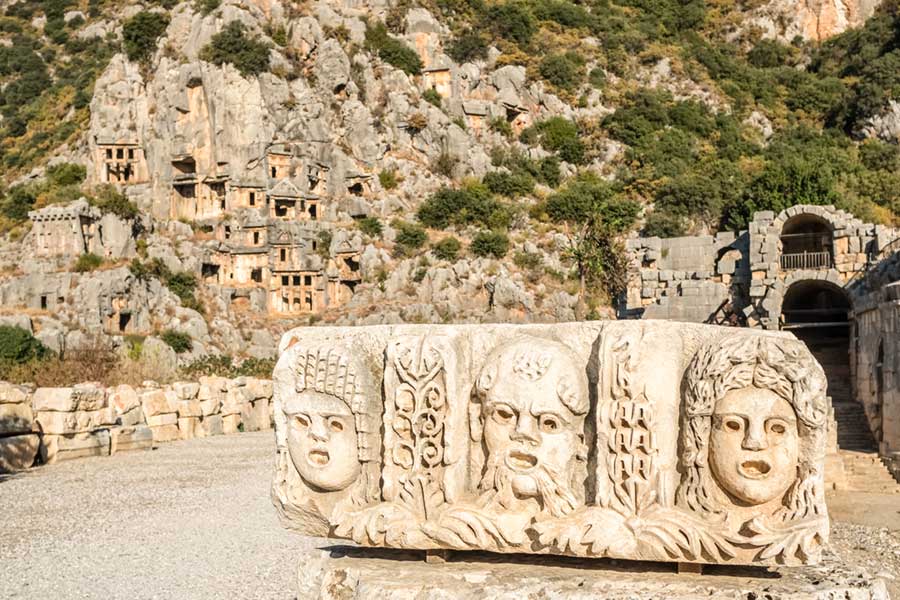
One of Lycia's most important cities, Myra offers a journey into the depths of history with its immortal cliff-carved tombs and magnificent Roman theatre.
Located about 30 km from Kaş in today's Demre district, Myra was one of the most powerful and influential cities of ancient Lycia. The city where Saint Nicholas served as bishop in the 4th century AD holds great significance for both religious and historical tourism today.
**Rock Tombs**
Myra's most striking feature is its Lycian rock tombs, masterfully carved into sheer cliff faces. The Lion Tomb and temple-façade tombs date from the 4th century BC and are notable for their vivid painted reliefs. Lycian inscriptions on some tombs are still legible.
**Roman Theatre**
The Roman theatre at Myra is one of the best-preserved in Anatolia. With a capacity of 11,000 spectators, the magnificent structure shares the same panorama as the rock tombs. The reliefs and masks on the stage building (scaenae frons) reflect the artistic sensibility of the era.
**The Saint Nicholas Connection**
Saint Nicholas, recognised in Christian tradition as the inspiration for Santa Claus, was born in Myra around AD 270 and served there as bishop. The church built in his name (the Church of Saint Nicholas) lies 1 km south of Myra.
All Travel Guides